
Pain with the first steps out of bed is a familiar feature of plantar fasciitis. However, several conditions can hurt under the heel. Understanding the pattern is more useful than assuming every sore heel needs the same treatment.
What is plantar fasciitis?
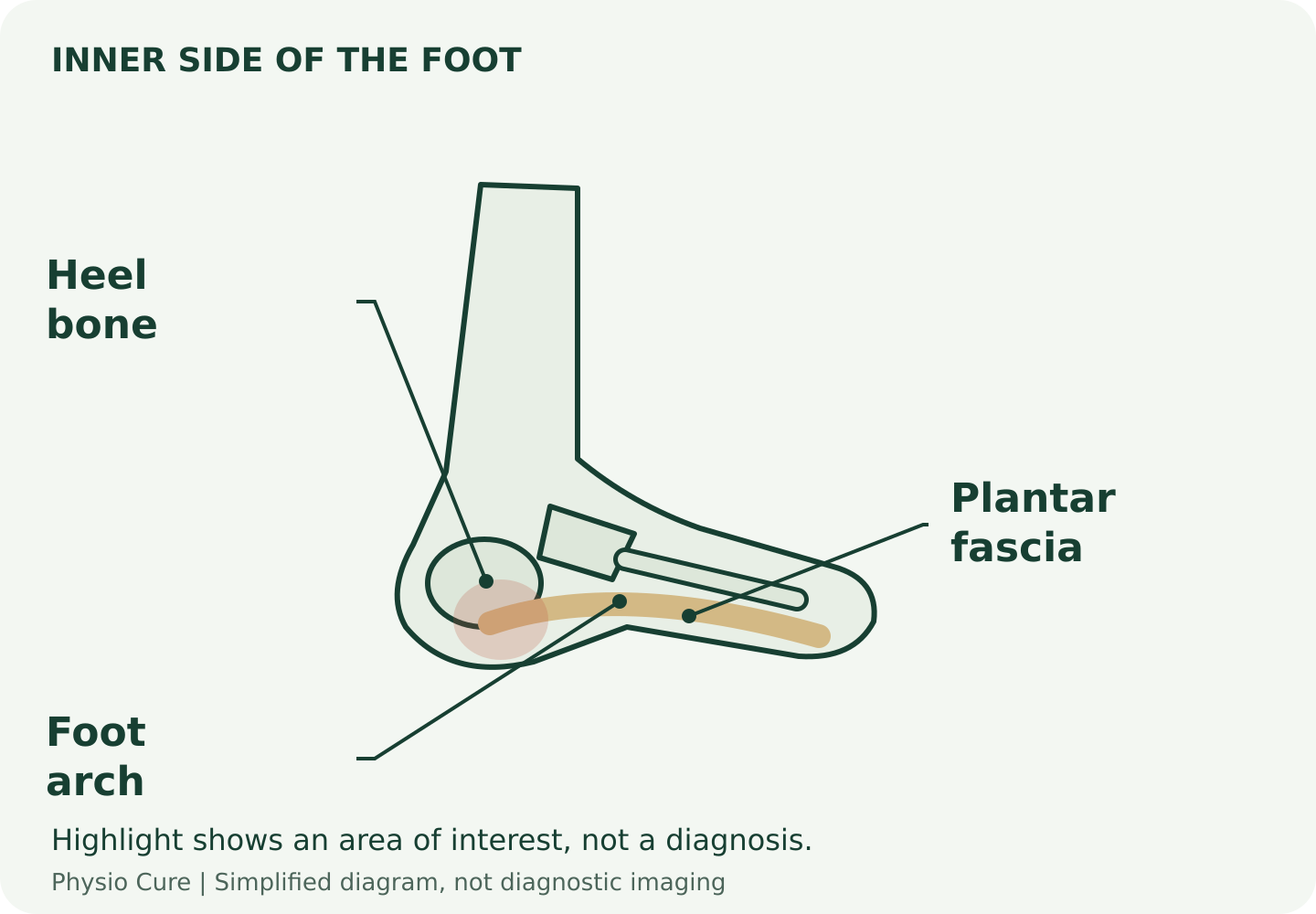
The plantar fascia is a strong band of connective tissue underneath the foot that helps support its arch. Plantar fasciitis, also called plantar fasciopathy, is a common cause of pain near its heel attachment. “Plantar heel pain” is a broader description that also includes other causes. [1]
Causes, risk factors and symptoms
A change in walking, running or standing demands may contribute. Symptoms often appear where the demands on the foot exceed its current tolerance, but a single cause is not always identifiable. [2]
Research has associated higher body mass and body mass index with plantar fasciitis in physically active populations. These are associations, not proof of a cause in any one person, and they do not mean that weight change is a prerequisite for receiving treatment. Risk-factor studies are often small or inconsistent. [3]
Typical symptoms include pain near the inner underside of the heel, tenderness and painful first steps after sleep or sitting. Longer periods of weight-bearing can also aggravate symptoms. [1, 2]
How physiotherapy assesses heel pain
A physiotherapist asks about the exact pain location, first-step symptoms, activity changes, injuries, health history and effect on walking. Examination may assess tenderness, ankle and toe movement, strength and tolerance of standing or walking. [1]
A typical pattern can support a clinical diagnosis, but no isolated symptom or test is conclusive. Imaging is not automatically necessary for a typical presentation. It may help when the findings are unusual or another condition is suspected. [6, 8]
What else could it be?
A differential diagnosis considers alternatives such as:
- Heel fat-pad pain, often felt more centrally under the heel.
- A heel-bone stress injury, particularly with increasing impact activity and progressive weight-bearing pain.
- Nerve irritation, which may involve burning, tingling or numbness.
- Achilles tendon or nearby problems, usually felt behind rather than underneath the heel. [6, 9]
Symptoms overlap, so these clues cannot confirm a diagnosis at home. Suspected bone stress needs assessment rather than an instruction to push through exercise. Early X-rays can miss stress injuries; the appropriate investigation depends on the clinical findings. [6]
Similar pain, different possibilities
Plantar fascia
Inner heel pain with first steps after rest is a common pattern.
Heel fat pad
Pain can be felt more centrally underneath the heel.
Bone stress
Progressive pain with weight-bearing needs assessment.
Nerve
Burning, tingling or numbness may indicate nerve involvement.
Patterns overlap. These clues do not establish a diagnosis.
Evidence-based treatment options
A sensible starting plan usually combines education, activity adjustments and targeted rehabilitation.
- Manage daily demands. Break up difficult periods of standing and adjust abrupt increases in walking or running. Choose comfortable footwear and discuss how to stay active within current tolerance. [2]
- Use appropriate exercise. Guidelines recommend plantar-fascia and calf stretching, alongside foot and ankle resistance exercise. The selection and progression should be tailored rather than copied from a generic programme. [1]
- Consider short-term support. Taping can help symptoms as part of a broader plan. The best-practice guide supports education, stretching and taping as core care, with additional options considered if progress is insufficient. [2]
- Select additional treatments carefully. Orthoses may be useful with other care, rather than as the sole short-term treatment. Night splints may be discussed for consistent first-step morning pain. [1]
For persistent symptoms, the diagnosis and plan should be reviewed before simply adding more treatment. Shockwave therapy is one option in stepped care, not a guaranteed cure or a necessary treatment for everyone. [2]
A 2026 network meta-analysis of 24 trials reported moderate-certainty evidence of short-term pain improvement when manual therapy, dry needling or low-level laser therapy was added to home exercise. These findings concern specific combinations and follow-up periods; they do not establish that a modality is best for everyone or effective on its own. Choices should consider potential harms, cost, preferences and response. [4]
A plan that adapts
Assess
Check the pain pattern, walking and alternative causes.
Adapt
Discuss activity demands and comfortable footwear.
Rehabilitate
Tailor stretching, strengthening and useful support.
Review
Review progress before adding further treatments.
The plan depends on the diagnosis, your goals and your response.
Recovery and when to seek care
Recovery varies, and persistent symptoms are possible. A systematic review found limited, mostly low-quality evidence for predicting who will improve. Avoid promises of a fixed recovery date. [5]
Seek prompt assessment after substantial injury, if you cannot bear weight, or for new numbness, progressive weakness or worsening unexplained rest pain. A rapidly red, hot, swollen foot or joint, particularly with fever or feeling unwell, requires urgent medical care. [6, 7]
General education only, not a diagnosis or personal exercise prescription. In an emergency in Australia, call 000.
Discuss your symptoms
For an individual assessment, book an appointment with Physio Cure.
Selected evidence and further reading
This is a focused summary of relevant guidance and research, not an exhaustive review of every journal article. Evidence checked 23 October 2026.
- Koc TA Jr et al. Heel Pain – Plantar Fasciitis: Revision 2023. J Orthop Sports Phys Ther. 2023;53(12):CPG1–CPG39. Clinical practice guideline; certainty and recommendation strength differ between treatments. https://doi.org/10.2519/jospt.2023.0303
- Morrissey D et al. Management of plantar heel pain: a best practice guide informed by a systematic review, expert clinical reasoning and patient values. Br J Sports Med. 2021;55:1106–1118. Combines trial evidence with expert and patient input; not every component is supported by isolated trials. https://bjsm.bmj.com/content/55/19/1106
- Hamstra-Wright KL et al. Risk Factors for Plantar Fasciitis in Physically Active Individuals: A Systematic Review and Meta-analysis. Sports Health. 2021;13(3):296–303. Associations in active populations do not establish individual causation. https://pmc.ncbi.nlm.nih.gov/articles/PMC8083151/
- Li Z et al. Efficacy of physical therapy interventions delivered with home exercise programs for pain and function in plantar fasciitis: a systematic review and network meta-analysis of randomized controlled trials. Phys Ther. 2026;106(6):pzag056. 24 trials; certainty depends on the comparison and outcome. https://pubmed.ncbi.nlm.nih.gov/42176209/
- Predicting the outcome of plantar heel pain in adults: a systematic review of prognostic factors. J Foot Ankle Res. 2023;16:28. Few studies and generally low-quality prognostic evidence. https://pmc.ncbi.nlm.nih.gov/articles/PMC10176769/
- Kaiser PB, Guss D, DiGiovanni CW. Republication of “Stress Fractures of the Foot and Ankle in Athletes”. Foot Ankle Orthop. 2023. Clinical review supporting differential diagnosis and investigation, not a treatment-effect systematic review. https://pmc.ncbi.nlm.nih.gov/articles/PMC10426306/
- Healthdirect Australia. Septic arthritis. Australian urgent-care safety information, not a peer-reviewed treatment study. https://www.healthdirect.gov.au/conditions/joint-and-muscle-diseases/septic-arthritis
- Mayo Clinic. Understanding plantar fasciopathy: Risk factors, diagnosis and management. 2023. Clinician educational resource supporting the imaging explanation, not a systematic review. https://www.mayoclinic.org/medical-professionals/physical-medicine-rehabilitation/news/understanding-plantar-fasciopathy-risk-factors-diagnosis-and-management/mac-20548770
- Allam AE, Chang KV. Plantar Heel Pain. StatPearls. Updated 4 January 2024. Clinical reference supporting alternative causes, not high-level treatment-effect evidence. https://www.ncbi.nlm.nih.gov/books/NBK499868/