
Pain when lifting a kettle, gripping tools or playing racquet sport can make ordinary tasks frustrating. Tennis elbow is a common explanation, but pain on the outside of the elbow is not always a tendon problem.
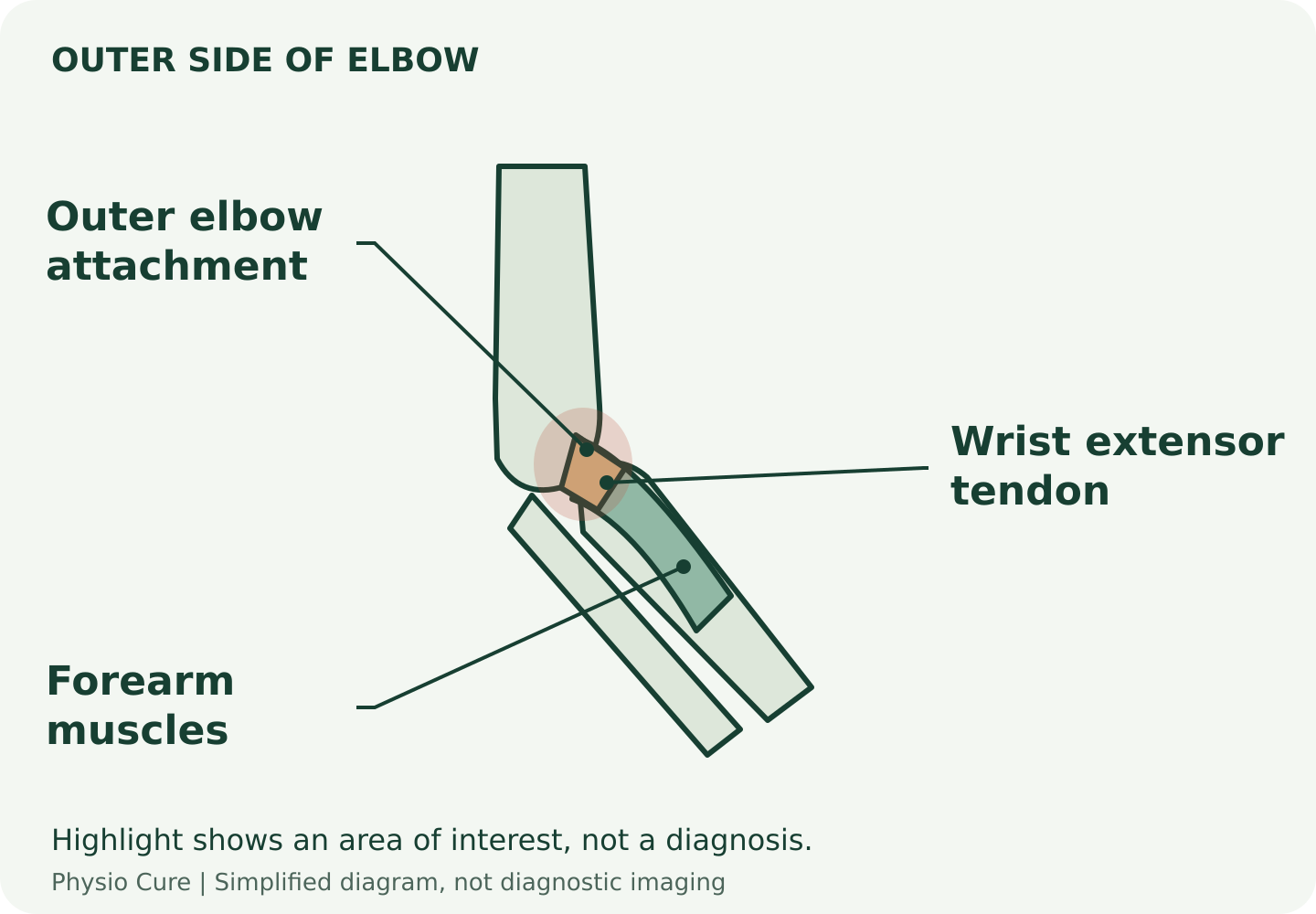
What is tennis elbow?
Tennis elbow, also called lateral elbow tendinopathy, involves pain and reduced function around the common wrist-extensor tendon attachment at the outside of the elbow. These muscles help lift the wrist and steady it during gripping. The term “tendinopathy” is more useful than assuming that every painful tendon is simply inflamed. [4]
Causes and typical symptoms
Symptoms may develop after increased gripping, lifting or repeated wrist work, although there is not always an obvious trigger. Tennis is only one possible activity. The amount and repetition of work, recovery opportunities and individual capacity can all matter. [2, 4]
Common features include:
- Local tenderness over the outer elbow.
- Pain during gripping, lifting or resisted wrist movement.
- Difficulty with tasks such as carrying shopping or using a screwdriver. [2]
Pain intensity alone does not show how much tissue damage is present. New numbness, marked swelling or a substantial loss of movement should not automatically be attributed to tennis elbow. [1, 4]
How a physiotherapist assesses it
Assessment starts with when symptoms began, work and sporting demands, injury history and the effect on everyday activities. Examination may include elbow and wrist movement, tenderness, grip strength and carefully selected resistance tests. The neck and nerves may also need checking. [1]
Together, these findings support a working clinical diagnosis. No single painful test proves the diagnosis or excludes every alternative. Further medical assessment or imaging may be appropriate when the pattern is unusual, trauma is significant or symptoms do not progress as expected. [4]
What else could cause similar pain?
These are examples of a differential diagnosis, not a self-diagnosis checklist:
- Nerve irritation near the elbow can cause pain further down the forearm or weakness.
- Referred pain or nerve irritation from the neck can produce arm symptoms.
- Joint problems, including arthritis or a loose fragment, may cause stiffness, catching or locking.
- Ligament injury or instability may follow trauma or cause a feeling of giving way. [4]
Patterns overlap. An examination helps decide whether physiotherapy, medical review or further tests are needed.
Similar pain, different possibilities
Tendon
Outer-elbow pain with gripping or lifting can fit tennis elbow.
Nerve or neck
Pain further down the forearm or weakness may need a nerve and neck assessment.
Joint
Stiffness, catching or locking may suggest a joint problem.
Ligament
Injury or a feeling of giving way may need an instability assessment.
Patterns overlap. These clues do not establish a diagnosis.
What treatment can reasonably offer
A plan should fit the person's goals and response, rather than promise that one exercise will cure everyone.
- Adapt difficult activities. Discuss manageable changes to gripping, lifting, workload and recovery breaks while maintaining tolerable activity. [1]
- Consider tailored rehabilitation. The 2022 physiotherapy guideline recommends resisted wrist-extensor exercise for subacute or persistent symptoms. The starting load and progression require individual assessment. [1]
- Review benefits rather than assuming success. A 2024 Cochrane review of 23 studies found that exercise, manual therapy or their combination may produce small improvements in pain and disability compared with minimal care. Evidence was low-certainty; benefits may not be clinically important or sustained. [2]
- Discuss uncertainty openly. A separate guideline found no clear advantage for exercise-based physiotherapy over no active treatment for pain and function. Differences in included studies and treatments help explain why recommendations vary. Assessment, advice and monitoring remain distinct from claiming a proven exercise cure. [3]
Hands-on treatment may offer short-term relief, but lasting benefit is uncertain. Treatment-related soreness can occur. Any worsening or poorly tolerated programme should be reviewed. Injections are not automatically a better next step: evidence does not establish a reliable lasting advantage for the commonly studied injection treatments. Discuss options and risks with an appropriate clinician. [2, 3]
A plan that adapts
Assess
Check symptoms, grip, movement and alternative causes.
Adapt
Discuss manageable changes to difficult tasks.
Rehabilitate
Consider tailored exercise, with realistic expectations.
Review
Check progress and revisit the diagnosis if needed.
Treatment benefits vary. No exercise or hands-on technique guarantees recovery.
When to seek medical care
Seek urgent care for a suddenly hot, swollen, very painful joint, particularly with fever or feeling unwell. After significant trauma, deformity or inability to use the arm also warrants prompt assessment. [5, 6]
Arrange medical review for progressive weakness, unexplained swelling, major stiffness or persistent unexplained rest/night pain. These features do not themselves prove serious disease, but deserve assessment. A 2026 review found that red-flag evidence largely came from case reports and series, so it cannot reliably predict an individual's diagnosis. [5]
General education only, not a diagnosis or personal exercise prescription. In an emergency in Australia, call 000.
Discuss your symptoms
For an individual assessment, book an appointment with Physio Cure.
Selected evidence and further reading
This is a focused summary of relevant guidance and research, not an exhaustive review of every journal article. Evidence checked 23 October 2026.
- Lucado AM et al. Lateral Elbow Pain and Muscle Function Impairments. J Orthop Sports Phys Ther. 2022;52(12):CPG1–CPG111. Clinical practice guideline. https://pubmed.ncbi.nlm.nih.gov/36453071/
- Wallis JA et al. Manual therapy and exercise for lateral elbow pain. Cochrane Database Syst Rev. 2024;5:CD013042. Systematic review; main treatment comparisons low-certainty. https://www.cochrane.org/evidence/CD013042_manual-therapy-and-exercise-treating-tennis-elbow
- Lapner P et al. Position statement: nonoperative management of lateral epicondylitis in adults. Can J Surg. 2022;65(5):E625–E629. Guideline based on comparative evidence; its exercise recommendation differs from the physiotherapy guideline. https://pmc.ncbi.nlm.nih.gov/articles/PMC9503571/
- Chung HJ et al. Differential Diagnosis of Elbow Pain. Ewha Med J. 2023;46(4):e13. Clinical narrative review, not a treatment-effect systematic review. https://pubmed.ncbi.nlm.nih.gov/40703946/
- Rossi F et al. The importance of identifying red flags in patients with elbow pain: A systematic review. J Hand Ther. Published online 10 April 2026. doi:10.1016/j.jht.2026.02.009. Mostly case reports/series; diagnostic accuracy remains uncertain. https://pubmed.ncbi.nlm.nih.gov/41966928/
- Healthdirect Australia. Septic arthritis. Australian urgent-care safety information, not a peer-reviewed treatment study. https://www.healthdirect.gov.au/conditions/joint-and-muscle-diseases/septic-arthritis