
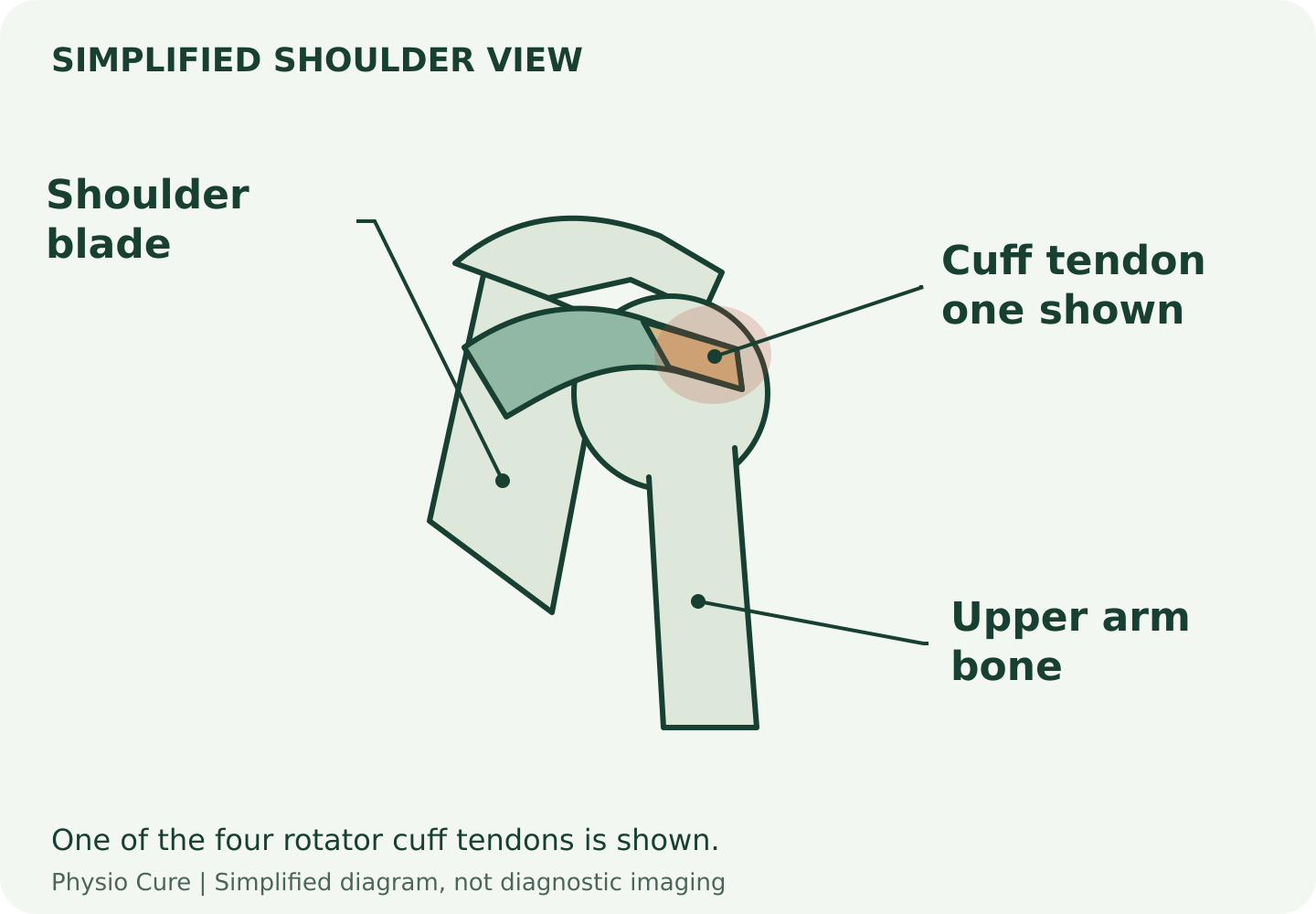
A visual explanation of the rotator cuff and how progressive exercise can help with painful reaching, lifting and shoulder use.
What is it?
The rotator cuff is a group of four muscles and tendons that help move and control the shoulder. Tendon-related pain commonly affects reaching or lifting. Pain does not necessarily mean a tear, and scan findings do not always explain symptoms.
- Pain with reaching or lifting
- Discomfort lying on the shoulder
- Reduced tolerance for overhead tasks
How physiotherapy may help
Match the diagnosis
Check shoulder movement, strength and other possible pain sources.
Train the shoulder
Use progressive resistance and movement-control exercises matched to tolerance.
Adjust the load
Temporarily change demanding tasks, then rebuild lifting and sport capacity.
Which additional treatments fit?
Manual therapy and taping
Hands-on techniques or taping may help short-term pain, alongside active rehabilitation rather than instead of it. Benefits and suitability vary. [1]
Shockwave
The 2025 guideline allows consideration for calcific tendinopathy, but recommends against it for rotator cuff tendinopathy without calcification. It is not a routine treatment for every painful shoulder. [1]
Therapeutic ultrasound
The guideline recommends against therapeutic ultrasound for both calcific and non-calcific rotator cuff tendinopathy. This treatment is different from diagnostic ultrasound used to assess structures. [1]
These recommendations concern rotator cuff tendinopathy, not every cause of shoulder pain. A treatment recommendation does not mean it is suitable for everyone or available at every clinic.
Everyday approach
Keep the shoulder moving within a manageable range. Rather than avoiding all use, reduce the most provocative loads and build them back gradually. Your physiotherapist can help decide how much discomfort is acceptable.
What to keep in mind
Hands-on care may ease symptoms in the short term but should not replace rehabilitation. Imaging or medical referral may be appropriate after trauma, with marked weakness or when progress is not as expected.
General educational information, not a diagnosis or personal treatment plan. For an emergency in Australia, call 000.
Sources and further reading
- [1] Desmeules et al. Rotator cuff tendinopathy diagnosis, nonsurgical medical care, and rehabilitation: clinical practice guideline (2025). JOSPT. doi:10.2519/jospt.2025.13182. Recommendations 26–33.
- Healthdirect: shoulder pain and when to seek urgent care
- Healthdirect: heart attack warning signs