
Exercise built around your life.
A physiotherapy-led program matched to your starting point, goals and response—then progressed as your capacity grows.
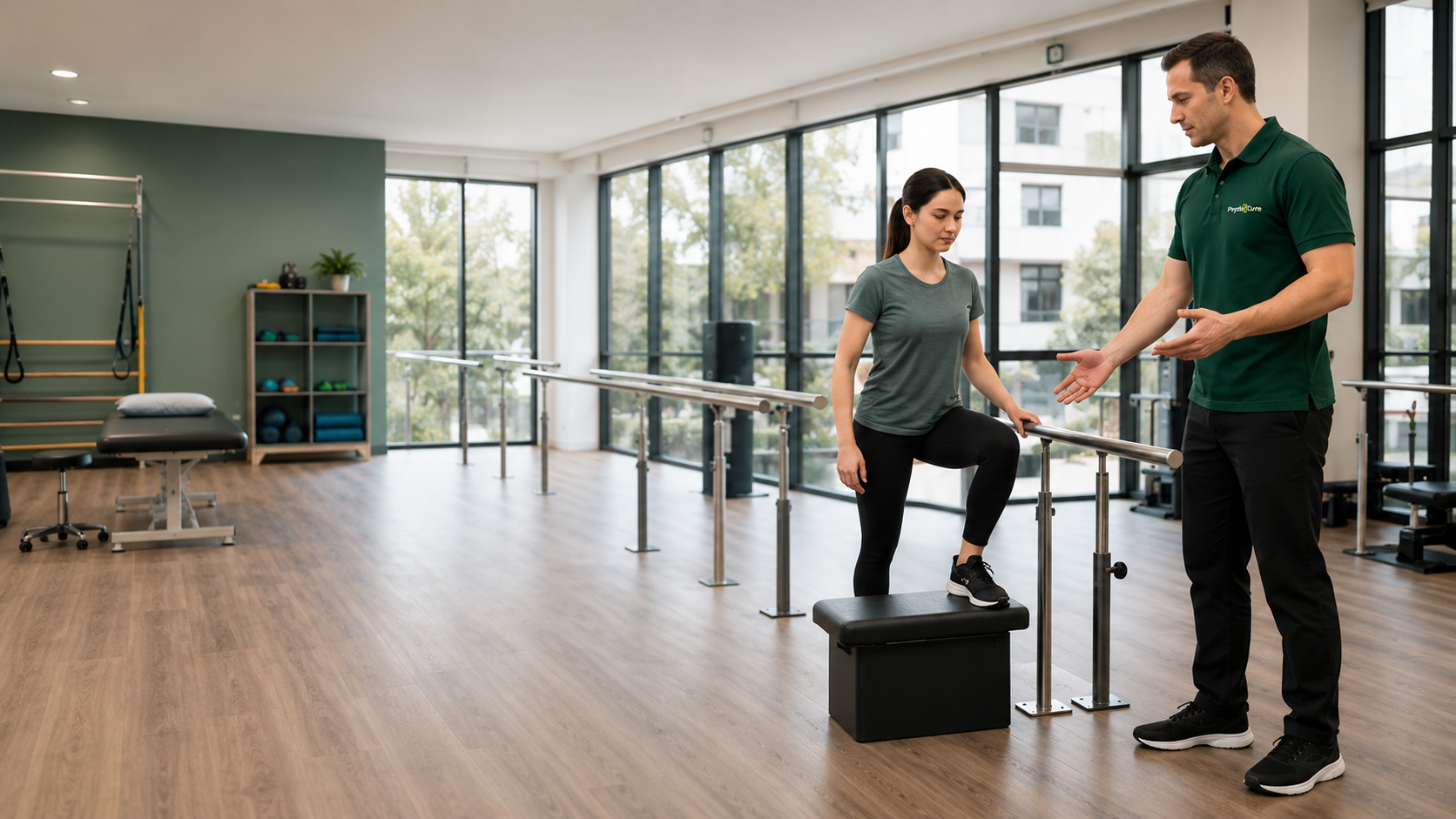
What would you like to do better?
Choose the goal closest to yours.
You do not need to know which exercises you need before booking.
Recover after injury or surgery
Restore relevant movement and gradually rebuild strength and function.
Explore this goalMove with less limitation
Improve mobility, capacity and confidence for meaningful everyday activities.
See what we assessImprove balance and independence
Practise relevant balance, strength and functional tasks at an appropriate level.
See program componentsReturn to work, activity or sport
Build and test the capacity required for the demands that matter to you.
Book an assessment
Your first appointment
A program begins with assessment—not a template.
We gather the information needed to understand your situation, assess relevant function and agree on a starting point that fits your goals.
Your needs and environment
- Symptoms, health history and relevant medicines
- Daily, work, caring, exercise or sporting demands
- Your goals, concerns and confidence
- Available space, equipment and support
Movement and capacity
- Relevant movement and joint function
- Strength, endurance or exercise tolerance
- Balance, coordination and movement control
- Functional tasks relevant to your goals
Individually selected
The building blocks of your program
Your plan may use only the components relevant to your goals.
Mobility and range
Relevant active movement, mobility and range-of-motion exercises.
Strength and endurance
Progressive resistance and capacity for repeated activity.
Balance and proprioception
Graded tasks for stability, awareness and confidence.
Movement control
Practice of relevant positions and movement strategies.
Aerobic conditioning
Appropriate walking, cycling or other cardiovascular activity.
Functional tasks
Sitting, standing, lifting, stairs or other daily activities.
Work or sport-specific drills
Progressive practice for the demands you plan to resume.
Education and load management
Understand dosage, recovery, pacing and progression.
Exercise prescription
More than a list of exercises.
A useful program explains what to do, how much, how challenging it should feel, how often to practise and how it may be progressed.
Start with an assessmentExercise
The movement or task selected for the goal.
Dosage
Sets, repetitions, distance, holds or time.
Intensity
How challenging the exercise should feel.
Frequency
How often it is planned and how recovery fits.
Progression
What changes when the current level is appropriate.
Your rehabilitation pathway
Progress according to response—not the calendar alone.
- 01
Understand and baseline
Clarify goals and establish relevant starting measures.
- 02
Learn the movements
Practise technique, dosage and safe alternatives.
- 03
Build consistency
Create a realistic routine and review the response.
- 04
Progress the challenge
Adjust load, volume, speed, range or complexity.
- 05
Test real-life function
Review relevant daily, work or sporting capacity.
- 06
Transition to self-management
Continue independently with clear next steps.
Flexible delivery
The right level of support for you.
Your physiotherapist can recommend supervised, independent or blended rehabilitation according to your needs.
Supervised rehabilitation
- Technique feedback and practical coaching
- Individual modifications and alternatives
- Confidence-building and graded challenge
- Progress reviews using relevant measures
Independent exercise program
- A practical program with clear dosage
- Options requiring minimal equipment where possible
- Exercises adapted to your available environment
- A progression and self-management focus
Reassessment
How progress may be measured
Measures are selected for your presentation and goals.
- Symptoms and recovery response
- Movement range
- Strength and endurance
- Balance and movement control
- Daily, work or caring tasks
- Sport-specific capacity
- Confidence and independence
Illustrative graphic only—these bars are not clinical scores or universal thresholds.
Responding to symptoms
What if an exercise does not feel right?
Continue as agreed
The response is expected, manageable and consistent with the plan discussed.
Modify and check
Symptoms are stronger or last longer than expected. Reduce, pause or contact your physiotherapist.
Stop and seek help
New severe pain, major swelling, new weakness or numbness, fainting, chest pain or serious breathing difficulty.
Practical by design
Designed to fit real life.

Clinical reasoning and review
Evidence-informed, individual and reviewed.
Exercise is commonly recommended within care for many musculoskeletal presentations, but its type and dosage should match the person and goal.
- A clear reasonEach exercise has an intended purpose.
- The expected responseYou know what to monitor.
- Relevant outcomes reviewedProgress is assessed, not assumed.
- The plan progressed or changedExercises adapt to your response.
Questions before booking
Exercise program FAQs
Still unsure? Email reception@physiocure.com.au or speak with a physiotherapist.
Speak with a physioDo I need a referral?
No referral is usually required for a private physiotherapy appointment. Some funding pathways, claims or programs may require a referral or other documentation.
Will I exercise at the first appointment?
Where appropriate, the first appointment normally includes assessment, explanation and introduction of selected exercises. The balance depends on the complexity and safety of your presentation.
What should I wear?
Wear comfortable clothing and suitable footwear that allow you to move and permit assessment of the relevant area. Bring braces, walking aids or sport equipment if requested.
Do I need gym equipment?
Not necessarily. Programs can often use body weight, household items or simple equipment. If equipment would be useful, your physiotherapist can discuss practical options.
How often should I complete the exercises?
Frequency depends on the goal, exercise type, intensity, health history and recovery response. Your program should state the planned dosage rather than rely on a universal schedule.
Is some discomfort acceptable?
The acceptable response varies by presentation. Your physiotherapist should explain what is expected, what to monitor and when to modify or stop. Severe, unusual or worsening symptoms require appropriate review.
What if I have other health conditions?
Tell your physiotherapist about relevant diagnoses, surgery, medicines, falls, cardiac or breathing symptoms and other concerns. The plan may need modification or medical clearance.
Can I do Clinical Pilates instead?
Clinical Pilates may suit some people who benefit from supervised individual or small-group exercise. An assessment can help determine whether it matches your needs and starting point.
How long will I need the program?
There is no universal duration. It depends on the goal, starting capacity, consistency, health factors and response. The aim is to build appropriate independence rather than create unnecessary treatment dependence.
Can I claim through private health insurance?
If the service is provided as physiotherapy, any rebate depends on your insurer, policy and available extras. Please check directly with your health fund. HICAPS displays the rebate determined by your fund.
Two Convenient Clinics
Choose the clinic that is most convenient for you.