
Patient education · Sport and movement
Pain with kicking, changing direction or squeezing the legs together deserves a clear assessment—not an automatic ‘groin strain’ label.
- Understand the painAssessment
- Rebuild capacityProgressive strength
- Return to demandsGradual activity
What is adductor-related groin pain?
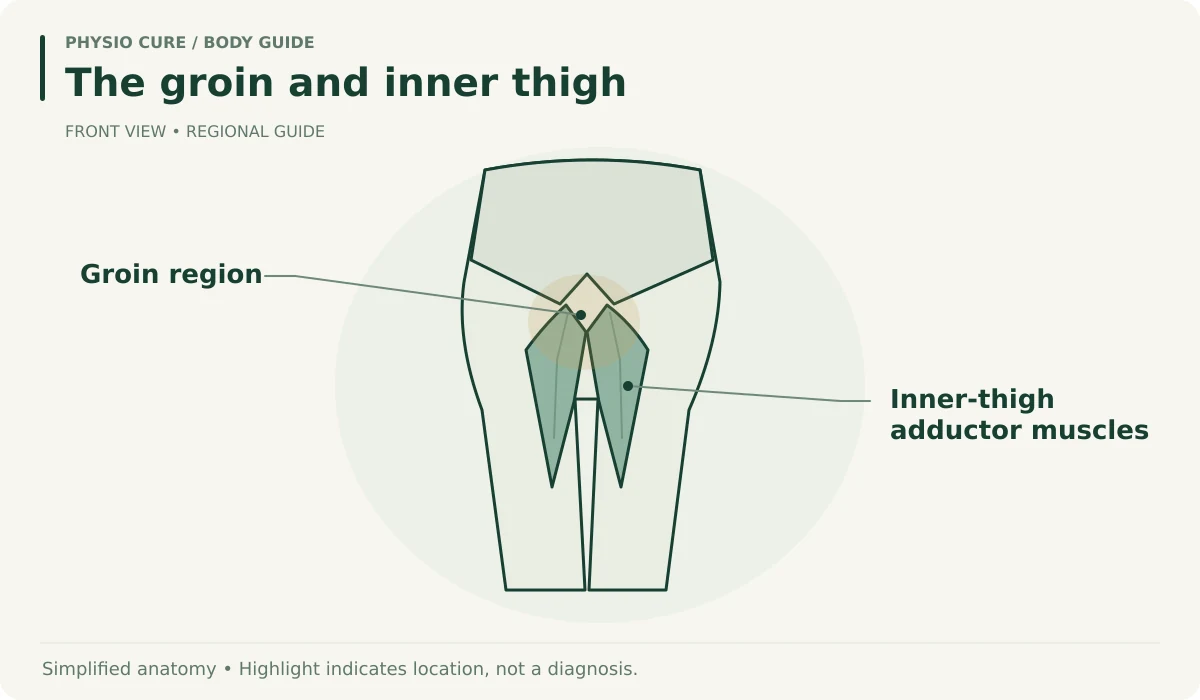
The adductors are the inner-thigh muscles that help bring the leg towards the body’s midline. Adductor-related groin pain describes a clinical pattern: familiar pain with pressure over these muscles and when they work against resistance. It is not a scan diagnosis or proof that a tendon is torn. Other causes can coexist. [1]
Why can it develop?
Symptoms may begin during a sudden sporting movement or build gradually with repeated loading. Kicking and rapid changes of direction place demands on this region. Previous groin problems and a mismatch between training demands and current capacity are relevant to assessment. [2] A recent systematic review found lower adductor strength associated with later groin pain in athletes. That association does not mean weakness is the sole cause, or that a strength test can predict an individual injury. [3]
What might you notice?
Discomfort is often felt near the inner upper thigh or its attachment towards the pubic region. Running, kicking or side-to-side movement may provoke it. A sudden injury can cause bruising or difficulty continuing sport. Symptoms and severity vary; pain location alone cannot identify the injured structure. [2]
What does physiotherapy assess?
Assessment explores onset, training changes and daily limitations, then examines tenderness, hip movement and muscle strength. Resisted adduction should reproduce the person’s recognisable symptoms—not simply any discomfort. No single examination or scan provides a complete answer. Imaging can show changes in people without pain and is considered when it will clarify suspected injury or change management. [1]
What else could explain groin pain?
Important alternatives include hip-joint problems, hip-flexor or pubic-related pain, hernia, pain referred from the back, and bone stress injury. In growing athletes, growth-plate or avulsion injuries also matter. Urinary, abdominal or reproductive conditions sometimes cause groin pain. A physiotherapist should refer when the presentation is outside musculoskeletal care or remains uncertain. [1]
How can treatment help?
Care usually combines education, adjustment of aggravating loads and progressively rebuilt strength and sporting capacity. The starting point depends on whether the problem is an acute injury or persistent pain. Rehabilitation may progress from tolerable strength work to running, direction changes and kicking; return to sport is guided by function and symptoms rather than a promised date. [2] A landmark trial found supervised active rehabilitation more effective than passive treatment alone for persistent adductor-related pain in male athletes. It supports active care, but does not establish one programme for everyone. [4]
When to seek medical help
Seek emergency care for sudden severe testicular pain, a painful groin lump with vomiting, or groin pain with fever. Prompt medical assessment is also important for worsening unexplained pain, a new lump or difficulty bearing weight after injury. Do not assume these are a sporting strain. [5]
If groin pain is limiting activity, contact Physio Cure to discuss an assessment. This is general education, not an individual diagnosis or exercise prescription.
Selected research and consensus sources checked on 27 October 2026; this is not an exhaustive review. Much sporting-groin research concerns male athletes, so findings may not apply equally to every patient.
Sources and further reading
- Weir A, et al. Doha agreement meeting on terminology and definitions in groin pain in athletes. British Journal of Sports Medicine. 2015;49:768–774.https://pmc.ncbi.nlm.nih.gov/articles/PMC4484366/Clinical definition, examination limits, imaging interpretation and differential diagnoses; foundational consensus, not a modern treatment guideline.
- Thorborg K. Current Clinical Concepts: Exercise and Load Management of Adductor Strains, Adductor Ruptures, and Long-Standing Adductor-Related Groin Pain. Journal of Athletic Training. 2023;58:589–601.https://pubmed.ncbi.nlm.nih.gov/35834724/Mechanisms, symptoms, load management and staged rehabilitation; clinical concepts review.
- Quintana-Cepedal M, et al. Is hip adductor or abductor strength in healthy athletes associated with future groin pain? A systematic review and meta-analysis. British Journal of Sports Medicine. 2025;59:501–509.https://pubmed.ncbi.nlm.nih.gov/39532315/Association between adductor strength and future groin pain; association is not individual prediction or proof of causation.
- Hölmich P, et al. Effectiveness of active physical training as treatment for long-standing adductor-related groin pain in athletes: randomised trial. Lancet. 1999;353:439–443.https://pubmed.ncbi.nlm.nih.gov/9989713/Active rehabilitation versus passive modalities in 68 male athletes; older, limited-population trial.
- Healthdirect Australia. Groin pain or swelling. Accessed 27 October 2026.https://www.healthdirect.gov.au/symptoms/aches-and-pains/groin-pain-or-swellingEmergency signs and medical review; Australian consumer triage reference supplemental to journal evidence.