
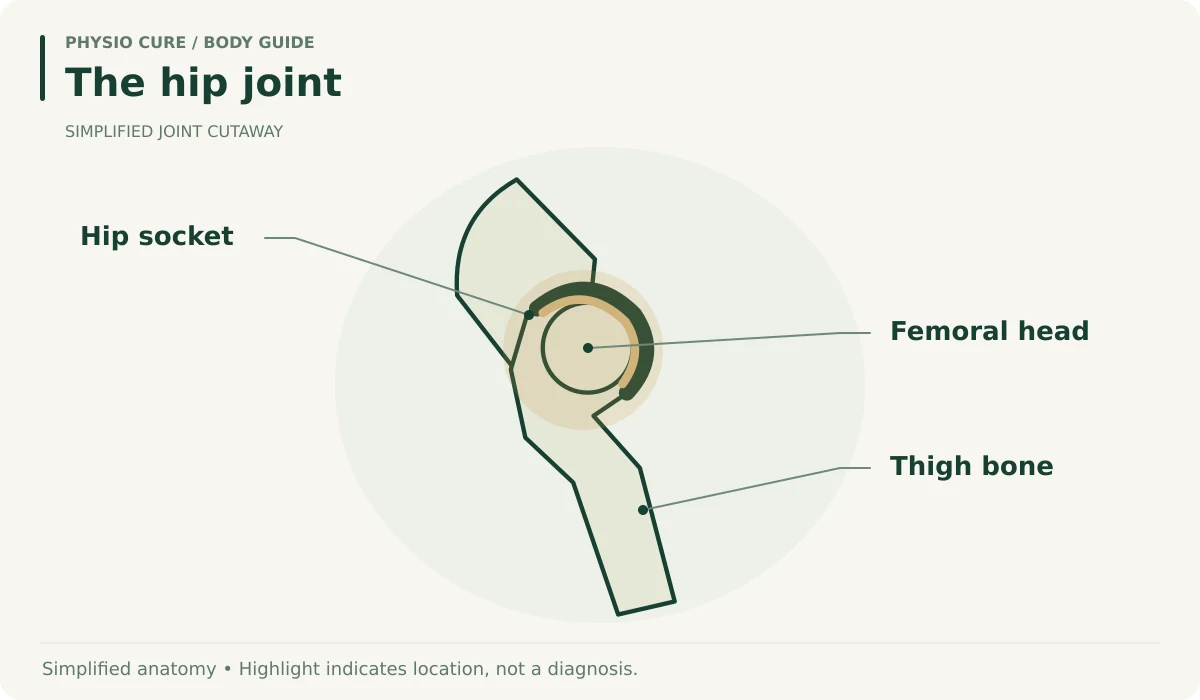
Hip pain can make walking, stairs or putting on shoes difficult. Osteoarthritis is one possible cause, but an assessment should consider the person’s symptoms and daily life, not simply a scan or their age.
Check symptoms and alternative causes.
Focus on activities that matter to you.
Tailor activity and discuss realistic benefits.
Adjust the plan or seek further assessment.
A flexible care pathway, not a diagnosis or fixed recovery timeline.
What is hip osteoarthritis?
Hip osteoarthritis involves changes in the joint, including cartilage and underlying bone. It may also be accompanied by reduced movement and muscle weakness. It is more complex than a joint simply wearing out, and treatment should not assume that everyone has the same symptoms or needs. [1]
Causes and risk factors
There is no single cause. Increasing age, previous hip injury, family history, higher body weight and differences in how the hip developed can contribute to risk. These factors do not establish a diagnosis, and people can develop hip osteoarthritis without an obvious risk factor. [2]
Common symptoms
Pain is often felt in the groin or front of the thigh, but can extend towards the buttock or knee. Stiffness after rest, reduced hip movement and difficulty walking or bending are common. Symptoms may fluctuate. Night pain can occur with osteoarthritis, but new, unexplained or rapidly worsening symptoms still need assessment. [2]
How a physiotherapist assesses hip pain
The conversation covers pain, stiffness, health history, previous injuries and meaningful activities. Examination may assess walking, hip movement, muscle strength, balance and tasks such as standing from a chair. The lower back or other regions may need examination when the pattern suggests a different source. Findings support a working diagnosis and a plan to review it. [1, 3]
Are scans always necessary?
No. NICE guidance supports a clinical diagnosis in adults aged 45 or over who have activity-related joint pain and either no morning stiffness or stiffness lasting no more than 30 minutes. Imaging may be needed for atypical findings or a suspected alternative diagnosis. These criteria are guidance for clinicians, not a home diagnostic test. [4]
What else can cause hip-area pain?
Pain over the outside of the hip may come from the gluteal tendons or nearby tissues. Back-related pain can be felt around the buttock or hip. Other joint problems, including impingement or a labral injury, can produce groin pain. A fracture or bone stress injury needs consideration after trauma or with an appropriate risk history. Symptoms overlap, so a single movement test cannot confirm every cause. [3]
What physiotherapy can offer
The 2025 hip guideline recommends individualised exercise addressing strength, mobility and endurance, alongside education and functional training. A plan can focus on tasks that matter to you, manageable activity changes and monitoring the response. A suitable walking aid may help when walking is difficult. Treatment should not promise to regrow cartilage or reverse all joint changes. [1, 4]
How strong is the exercise evidence?
A July 2026 Cochrane review included 18 studies with 1,368 adults. Compared with usual care, no treatment or limited education, exercise probably produced small average improvements in pain and function that may not be noticeable in everyday life. Compared with placebo or attention control, it may have little or no effect on pain and a small effect on function. [5]
These findings support realistic expectations rather than abandoning activity or promising a cure. The evidence has limitations, including small studies and participants knowing their treatment. Results describe group averages; progress should be judged against the individual’s goals and response. [5]
Is one exercise programme best?
A 2024 trial compared progressive resistance training with neuromuscular exercise, which emphasises control and functional stability. Neither was superior for the measured function, pain or quality-of-life outcomes. Both were active programmes, so the trial does not prove how either compares with no treatment. Preferences, capacity and access can help guide selection. [6]
Other options and next steps
Manual therapy can be considered alongside exercise, not as a proven stand-alone solution. Weight-management support may be discussed where relevant and wanted. Medicines require an individual discussion with a GP or pharmacist. If symptoms substantially affect quality of life and non-surgical care is ineffective or unsuitable, an orthopaedic opinion may be appropriate; physiotherapy should not delay that conversation. [4]
When to seek medical care
Seek urgent assessment if you cannot bear weight after a fall, or develop sudden severe joint pain with fever or feeling unwell. A hot, swollen joint also needs urgent assessment. Persistent unexplained rest pain, rapid deterioration or other unusual symptoms warrant medical review rather than assuming an arthritis flare. [3, 4, 7]
General educational information, not a diagnosis or personal exercise prescription. In an emergency in Australia, call 000.
Selected evidence and further reading
Evidence checked 24 October 2026 (Melbourne). This is a focused selection of relevant research and guidance, not an exhaustive review of every journal article.
- Koc TA Jr et al. Hip Pain and Mobility Deficits–Hip Osteoarthritis: Revision 2025. J Orthop Sports Phys Ther. 2025;55(11):CPG1–CPG31. Updated physiotherapy clinical practice guideline. Read source 1
- American Academy of Orthopaedic Surgeons. Hip Osteoarthritis. Patient education supporting symptoms and risk factors, not a treatment-effect systematic review. Read source 2
- Chamberlain R. Hip Pain in Adults: Evaluation and Differential Diagnosis. Am Fam Physician. 2021;103(2):81–89. Clinical review for alternative diagnoses and assessment. Read source 3
- NICE. Osteoarthritis in over 16s: diagnosis and management. NG226. 2022. Evidence-based guideline; recommendations cover osteoarthritis broadly and should not be mistaken for hip-only trial results. Read source 4
- Hall M et al. Exercise for osteoarthritis of the hip. Cochrane Database Syst Rev. 2026;7:CD007912. doi:10.1002/14651858.CD007912.pub3. Updated systematic review; evidence searched to February 2025; certainty varies by comparison. Read source 5
- Kjeldsen T et al. Progressive Resistance Training or Neuromuscular Exercise for Hip Osteoarthritis: A Multicenter Cluster Randomized Controlled Trial. Ann Intern Med. 2024;177:573–582. Participants and physiotherapists were not blinded; no inactive control group. Read source 6
- Healthdirect Australia. Septic arthritis. Australian urgent-care information, not a treatment-effect research paper. Read source 7