
Understand the shoulder capsule, why movement becomes restricted and how a paced rehabilitation plan can help.
What is it?
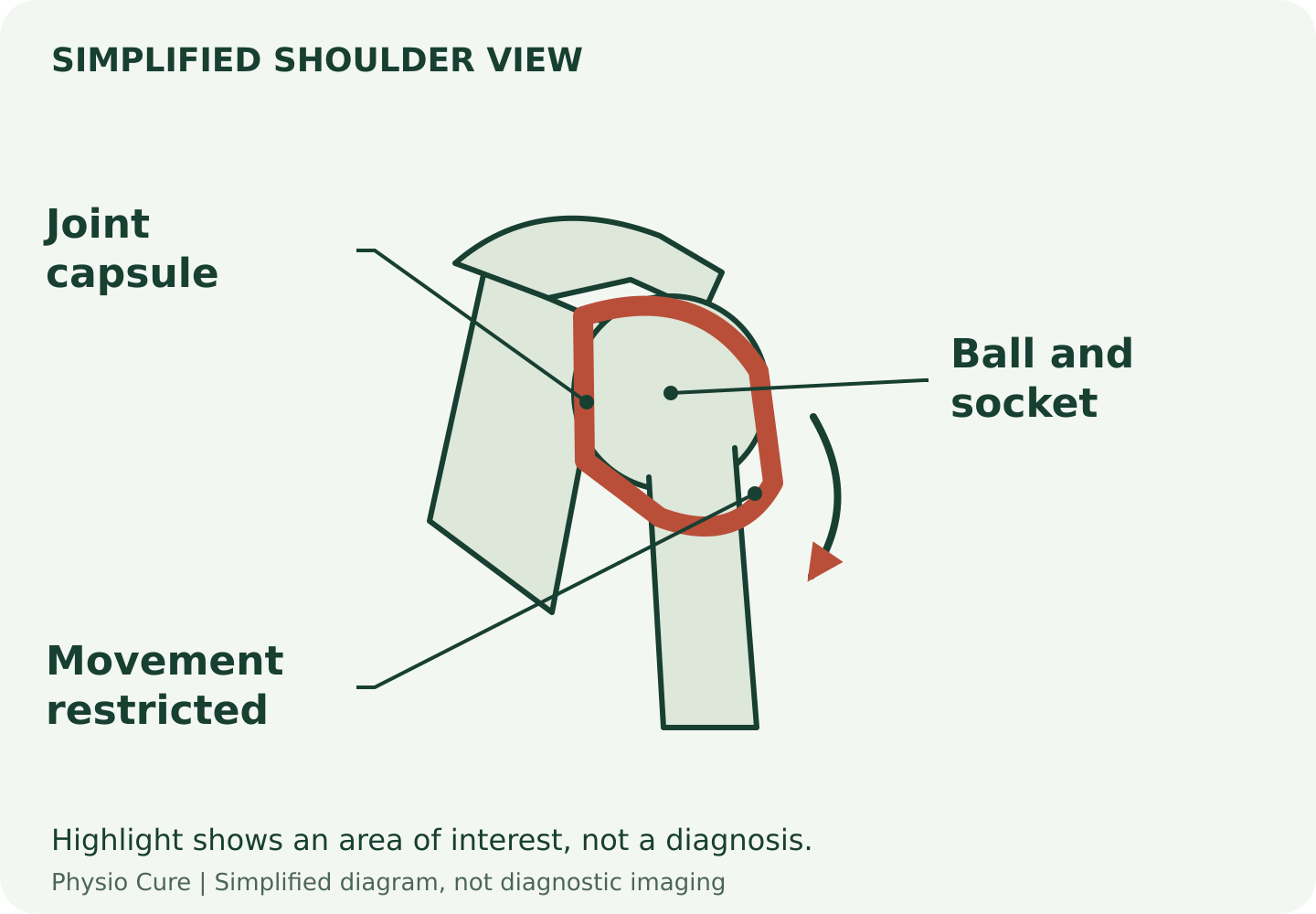
Frozen shoulder involves pain and substantial stiffness as the joint capsule becomes restricted. Both moving the arm yourself and having someone gently move it are limited. Reaching behind the back or turning the arm out can become difficult.
- Progressively restricted movement
- Pain that may disturb sleep
- Difficulty dressing or reaching
Causes, assessment and alternatives
Frozen shoulder may arise without a clear trigger or after injury or reduced shoulder use. Diabetes is associated with greater risk. Assessment checks both active and assisted movement and considers arthritis, rotator cuff problems and other causes. Imaging may help exclude alternatives; it is not a substitute for examination. Assessment guidance
How physiotherapy may help
Confirm the pattern
Check that the symptoms fit and consider other causes of a stiff shoulder.
Pace movement
Use range-of-motion work matched to the pain and stiffness rather than forceful stretching.
Build function
Gradually add strength and practise useful daily movements as tolerance improves.
Everyday approach
Use a comfortable range and modify tasks while the shoulder is irritable. More force is not necessarily better. A GP may discuss pain relief or an injection to help you participate in rehabilitation.
What to keep in mind
Recovery varies and can leave lasting restriction. Evidence that physiotherapy alone speeds natural recovery is uncertain; treatment focuses on useful movement and symptom management. Persistent disabling symptoms warrant medical review.
General educational information, not a diagnosis or personal treatment plan. For an emergency in Australia, call 000.
Sources and further reading
Selected guidance and research; this brief guide is not an exhaustive evidence review.