
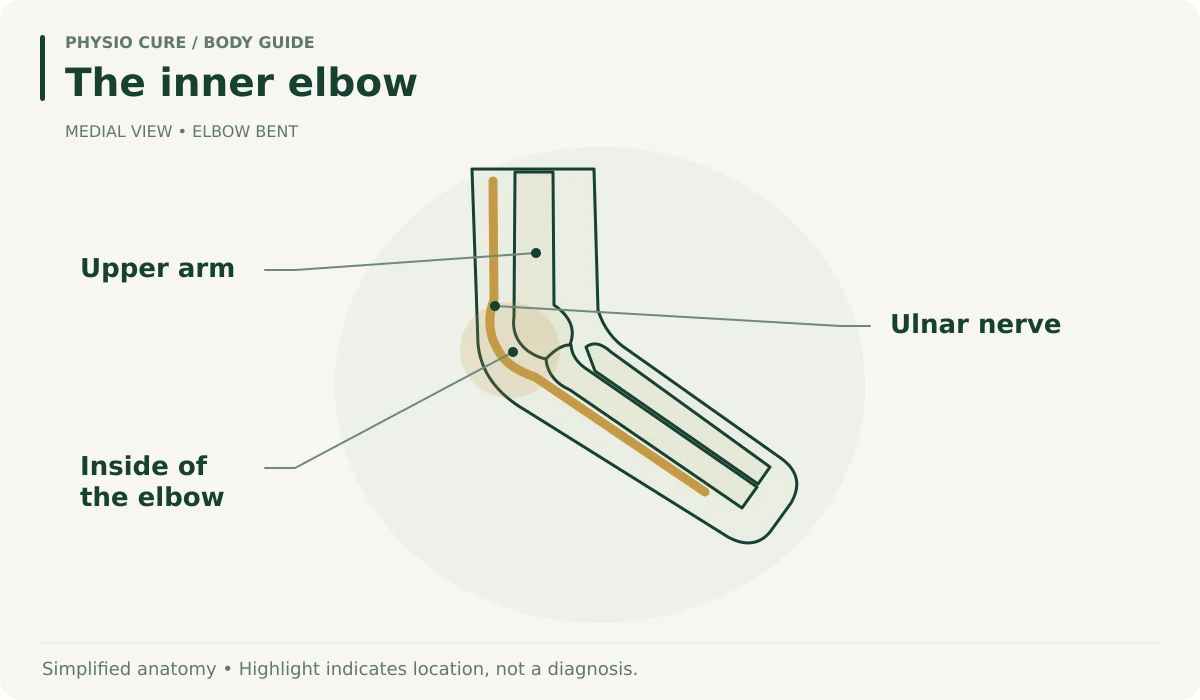
Tingling in your little finger can be easy to dismiss, especially when it comes and goes. One possible explanation is cubital tunnel syndrome: irritation or compression of the ulnar nerve around the inside of the elbow. The nerve supplies feeling to the little finger and part of the ring finger, and helps control small hand muscles. British Society for Surgery of the Hand
Why does it happen?
The ulnar nerve passes close to the surface behind the elbow's inner bony prominence, near the “funny bone”. Prolonged elbow bending can stretch and compress it; leaning on the elbow adds direct pressure. Symptoms may therefore appear during sleep, driving or phone use. Previous elbow injury, arthritis, swelling or a nerve that moves out of its usual position can contribute. Often, there is no single identifiable cause. AAOS patient guidance
Symptoms worth noticing
Common features include:
- Pins and needles or numbness in the little finger and little-finger side of the ring finger.
- Symptoms that worsen with a bent elbow or interrupt sleep.
- Sometimes, aching around the inner elbow.
- In more advanced cases, weaker grip, clumsy finger movements or visible loss of hand muscle bulk.
These patterns are clues, not a diagnosis. AAOS patient guidance
How is it assessed?
Assessment considers when symptoms occur, their distribution, previous injuries and changes in hand function. Examination checks sensation, strength and muscle bulk, and looks beyond the elbow when needed. Similar symptoms can arise from an irritated nerve in the neck, the nerve network near the shoulder, or ulnar nerve compression at the wrist. Carpal tunnel syndrome involves a different nerve. Medical Journal of Australia review
Nerve conduction studies, sometimes with electromyography, can help establish the location and severity of nerve dysfunction. A normal result does not completely exclude a mild problem. Ultrasound can complement the examination and electrical tests by assessing the nerve around the elbow. No single scan or test should be interpreted without the clinical picture. AANEM diagnostic guideline
Where can physiotherapy fit?
For mild sensory symptoms, non-operative management may include education, modifying provoking activities and hand therapy. A physiotherapist can help identify relevant pressures and positions and review whether symptoms and function are changing. Medical Journal of Australia review
It is important to be realistic about the evidence. The 2025 Cochrane review found limited evidence for conservative treatments. In one small trial, advice about avoiding provoking positions helped some people; adding nerve-gliding exercises or night splints did not show extra improvement in work activities or night pain. This does not prove that these approaches never help, but it does not support promising a cure. Cochrane review
A separate 2025 review rated evidence for night splints as very low certainty. It could not establish whether splints outperform advice alone. Whether to trial a splint, or include exercises, should therefore be an individual discussion rather than an automatic prescription. Night-splint systematic review
When should you seek medical review?
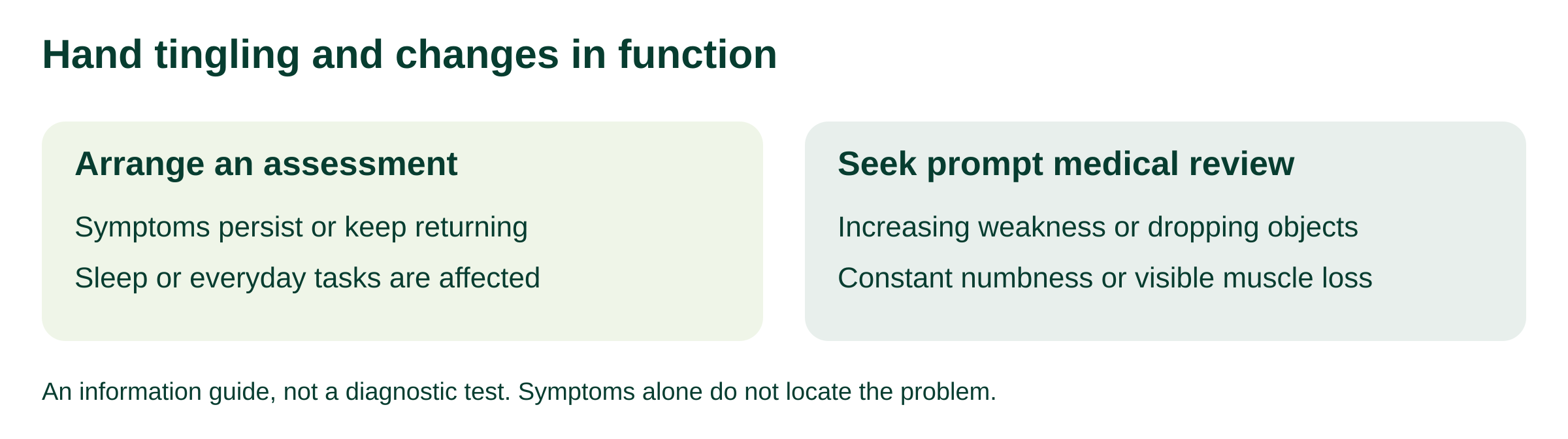
Arrange assessment if symptoms persist, keep returning or affect sleep and everyday tasks. Seek prompt medical review for increasing weakness, dropping objects, constant numbness or visible muscle wasting. Do not wait for an exercise programme to work if hand function is deteriorating. Severe or persistent compression may require specialist assessment and consideration of surgery; longstanding muscle loss may not fully recover. British Society for Surgery of the Hand
The practical takeaway: recurring hand tingling deserves an explanation. Establishing which nerve is affected, and whether there is weakness, is more useful than guessing from a symptom diagram.
General education from Physio Cure, not a diagnosis or an individual treatment plan.
Sources and evidence
Selected evidence checked 28 October 2026; this is not an exhaustive review.
- British Society for Surgery of the Hand. Cubital tunnel syndrome.https://www.bssh.ac.uk/patients/conditions/22/cubital_tunnel_syndrome
- American Academy of Orthopaedic Surgeons, OrthoInfo. Ulnar Nerve Entrapment at the Elbow (Cubital Tunnel Syndrome).https://www.orthoinfo.org/diseases–conditions/ulnar-nerve-entrapment-at-the-elbow
- Davis GA, Day TJ (2022). Peripheral nerve entrapment: how to diagnose and when to refer. Medical Journal of Australia 216(3):126-130.https://www.mja.com.au/journal/2022/216/3/peripheral-nerve-entrapment-how-diagnose-and-when-refer
- Shook SJ, Ginsberg M, Narayanaswami P, et al. (2022). Evidence-based guideline: Neuromuscular ultrasound for the diagnosis of ulnar neuropathy at the elbow. Muscle & Nerve 65(2):147-153.https://www.aanem.org/docs/default-source/documents/practice/evidence-based-guideline-nm-us-diagnosis-ulnar-neuropathy-elbow.pdf?sfvrsn=7d399e6e_1
- Caliandro P, La Torre G, Padua R, Giannini F, Reale G, Padua L (2025). Treatment for ulnar neuropathy at the elbow. Cochrane Database of Systematic Reviews Issue 4:CD006839.https://doi.org/10.1002/14651858.CD006839.pub5
- Bateman M, Swaile H, Tambe A (2025). Effectiveness of night splints for cubital tunnel syndrome – A systematic review. Hand Therapy 30(3):105-112.https://pubmed.ncbi.nlm.nih.gov/40385935/