
PHYSIO CURE · PATIENT INFORMATION
Pain on the outside of your knee that builds during a run can be frustrating. Iliotibial band syndrome (ITBS) is one possible explanation, but several conditions cause similar symptoms. Assessment helps guide a sensible return to activity.
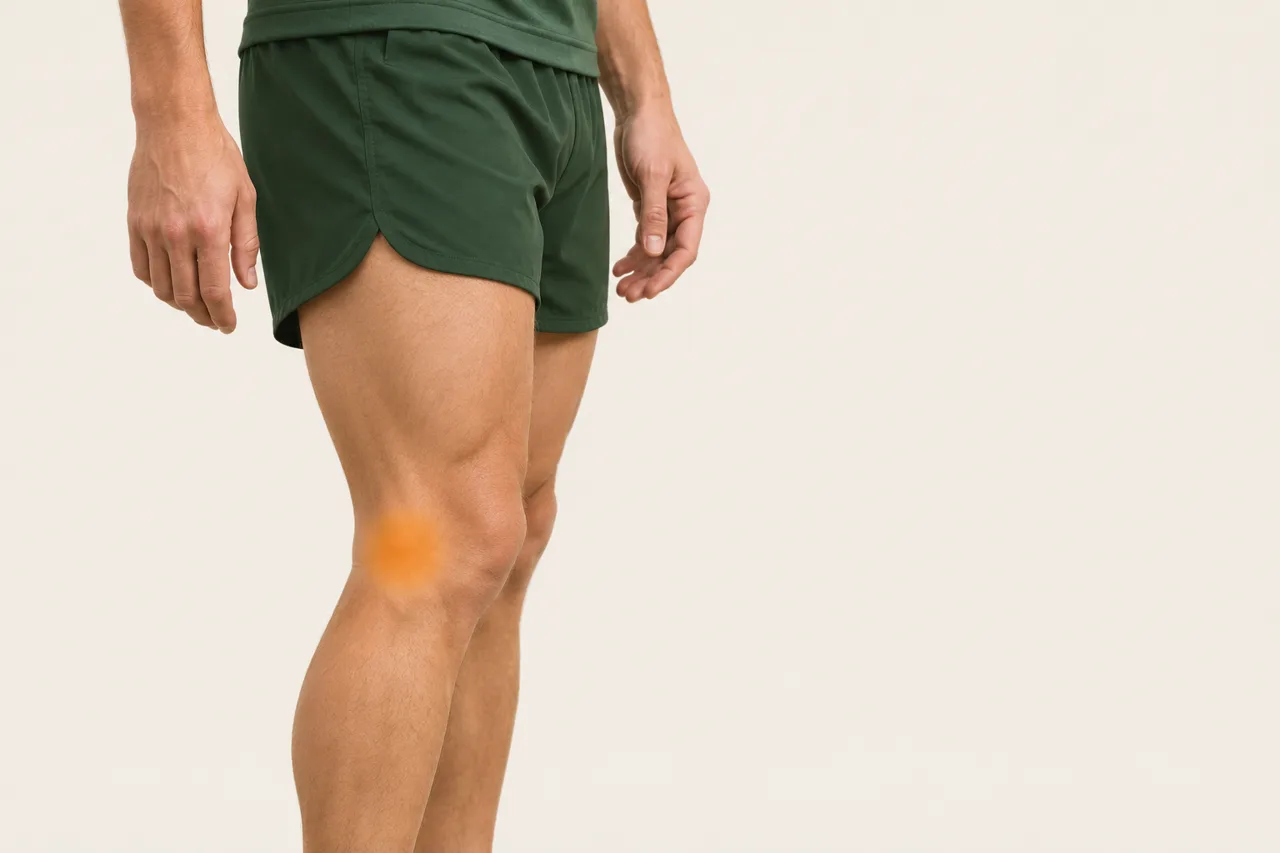
What is IT band syndrome
The iliotibial band is a strong strip of connective tissue along the outer thigh. ITBS describes activity-related pain near its outer-knee region, commonly in runners and cyclists. Compression of sensitive tissues beneath the band is a leading explanation; the exact pain mechanism remains debated. Calling it a band that simply “rubs” or needs “loosening” oversimplifies the anatomy. [1, 2]
What contributes to it
A recent increase in running distance, speed or downhill training can precede symptoms. [3] Hip and knee movement patterns may also matter, but there is no single proven cause. Hip weakness can accompany pain without necessarily having caused it. Assessment should consider your training history rather than blame one muscle, shoe or running style. [1]
Typical symptoms include:
- Localised pain near the outer knee, often just above the joint line.
- Pain that builds with running, especially downhill or faster efforts.
- Discomfort descending stairs when the area is more sensitive. [3]
- STEP 1Adjust loadReduce provoking running conditions
- STEP 2Build capacityProgress suitable strength and control
- STEP 3Return graduallyRebuild running as symptoms allow
How physiotherapy assesses it
Your physiotherapist asks about onset, training changes, injury, swelling and symptoms elsewhere. Examination checks tenderness, knee movement, strength and functional tasks; running may be observed when appropriate. [3, 6]
Pain reproduction with a Noble compression test can support the assessment, but its diagnostic accuracy is uncertain. An Ober “tightness” test cannot reliably establish ITBS or measure the band’s tightness. [1]
Important alternatives include kneecap-related pain, a lateral meniscal injury, lateral ligament injury, osteoarthritis, bone stress injury, and pain referred from the hip or lower back. [1, 6]
Scans are not automatically needed for suspected ITBS. Persistent, atypical or traumatic pain may need medical review and targeted imaging to investigate another cause; a physical examination cannot exclude every condition. [1, 5]
What treatment can involve
An individual plan usually combines:
- Adjusting load. Temporarily reduce the running conditions that provoke symptoms. Keep tolerable activity where possible, then rebuild gradually rather than repeatedly testing a painful run. [3]
- Progressive exercise. Hip and lower-limb strengthening, balance and controlled single-leg tasks can help rebuild capacity. Exercises should match your findings and goals. [2]
- A planned return to running. Progress distance, speed and hills according to symptoms and function. Selected runners may trial changes to running technique; evidence for a standard gait-retraining recipe remains limited. [1, 3]
Manual treatment, stretching or foam rolling may be optional additions. A small 2026 trial suggested benefits from adding rolling and stretching to strengthening, but could not separate their effects or establish lasting benefit. These findings do not prove that the band was lengthened or “released”. [1, 4]
A 2026 systematic review supports structured rehabilitation as a reasonable first approach, while emphasising that studies differ greatly and no single programme is clearly best. Persistent symptoms deserve reassessment before considering other treatments. [2]
When to seek medical help
Seek urgent medical assessment for a hot, red, swollen knee with fever, or an injury followed by severe swelling or inability to bear weight. A knee that is physically locked and cannot straighten also needs prompt assessment. Arrange review for worsening symptoms, unexplained rest or night pain, or failure to improve with an appropriate plan. [6]
This is general education, not an individual diagnosis. Physio Cure can assess your symptoms and discuss suitable next steps.
Evidence checked November 2026. These are selected relevant sources, not an exhaustive review.
Selected sources
Sources checked 5 November 2026. A focused evidence selection, not an exhaustive review.
- The Iliotibial Band: A Complex Structure with Versatile Functions
- Extreme Diagnostic and Therapeutic Heterogeneity Limits Treatment Conclusions in Iliotibial Band Syndrome: A Systematic Review with Level-of-Evidence Stratification
- Current Clinical Concepts: Synthesizing the Available Evidence for Improved Clinical Outcomes in Iliotibial Band Impingement Syndrome
- Evaluating treatment efficacy for Iliotibial Band Syndrome: A comparison of combined foam rolling and stretching with strengthening exercises versus strengthening alone in athletes
- ACR Appropriateness Criteria® Chronic Knee Pain: Update 2026
- Knee Pain in Adults and Adolescents: The Initial Evaluation
Original educational illustrations. General information, not an individual diagnosis or treatment prescription.