
Do your legs become painful or heavy when you walk, then settle when you sit down? Lumbar spinal stenosis is one possible explanation, but other conditions can cause similar symptoms. An assessment matters before choosing treatment. [3]
- Recognise a patternLeg symptoms with walking. Sitting may bring relief.
- Check the causeAssess nerves and circulation. A scan alone is not a diagnosis.
- Build useful activityTailor exercise and pacing. Review walking and function.
What is lumbar spinal stenosis?
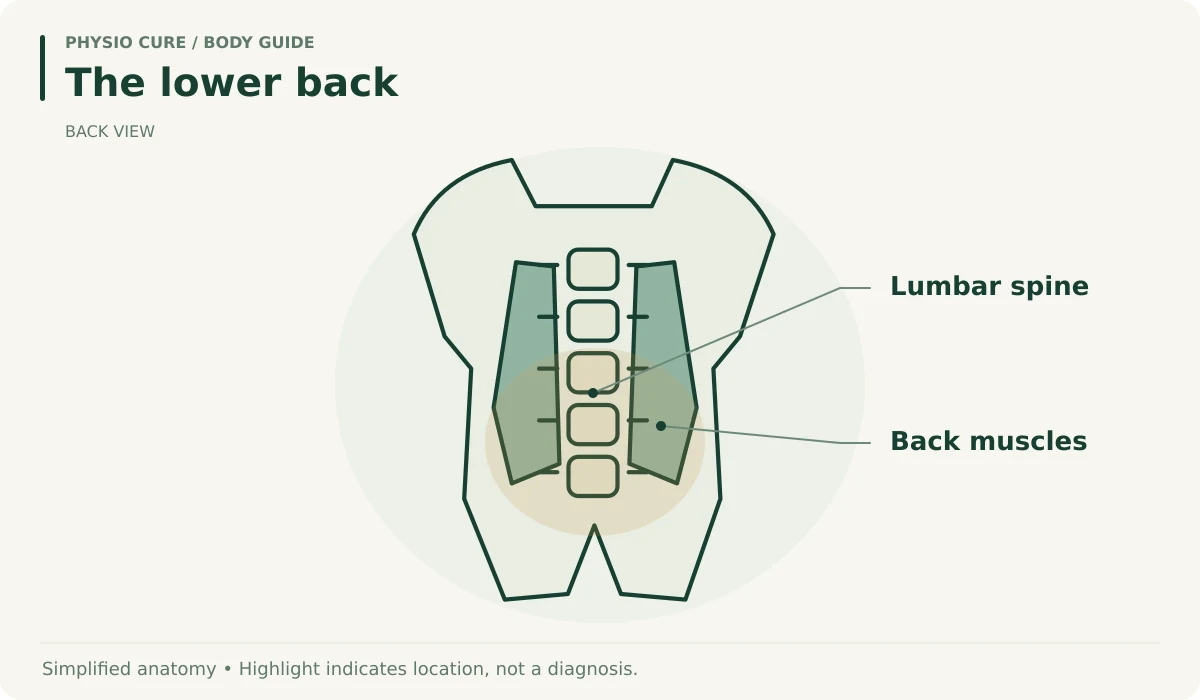
Lumbar spinal stenosis means narrowing of spaces around the nerves in the lower back. It commonly develops with age-related changes in the discs, joints and ligaments. A naturally narrower spinal canal or a slipped vertebra, called spondylolisthesis, can also contribute. These changes may irritate or compress nerves. [1]
Importantly, narrowing on a scan does not automatically explain someone’s pain. Some people have stenosis on imaging without symptoms. Diagnosis brings together the symptom pattern, examination and, when appropriate, imaging. [2]
Recognising neurogenic claudication
Neurogenic claudication describes buttock or leg pain, tingling, numbness, heaviness or weakness brought on by standing or walking. Symptoms often ease with sitting or leaning forwards, such as over a shopping trolley. Back pain may also occur, but is not essential. Walking tolerance can be affected. [2,4]
What should an assessment check?
A physiotherapy assessment explores what brings symptoms on, what settles them and how walking and daily activities are affected. Examination may include walking, balance, leg strength, sensation, reflexes, hip movement and circulation screening. No single physical test confirms the diagnosis. MRI can help clarify the anatomy when clinically indicated, but scan severity alone does not reliably measure symptom severity. [1,2]
Other explanations need consideration. Vascular claudication comes from reduced arterial blood flow. Pain may ease by simply stopping, without sitting or bending. Symptom clues alone are unreliable; circulation assessment may be needed, and vascular disease can coexist with stenosis. [2,3]
Hip osteoarthritis and peripheral neuropathy, including diabetes-related nerve problems, can cause overlapping pain or sensory symptoms and need different management. [1]
How can physiotherapy help?
The aim is to improve activity tolerance and daily function, not to promise that exercise will reverse structural narrowing. The 2021 clinical guideline supports an individualised combination of education, activity advice, exercise and, where appropriate, manual therapy. Its recommendations are conditional, rather than a guarantee of benefit. [4]
A 2022 systematic review found moderate-quality evidence supporting programmes combining manual therapy and exercise, with or without education. Benefits included symptoms, function or walking distance in particular trials; evidence for many other non-surgical treatments remained uncertain. [5]
A 2024 exercise review found that strengthening, stretching, fitness work such as cycling, and psychologically informed approaches appeared more often in successful programmes. This association does not prove that any one component works on its own, and the best exercise dose remains unclear. Your programme should therefore reflect your symptoms, abilities and goals rather than a generic exercise list. [6]
Your physiotherapist can help you find tolerable ways to remain active, plan breaks and adjust your programme over time. Progress should be reviewed against goals that matter to you, such as walking to the shops. [4]
When is medical review needed?
Persistent, disabling symptoms despite appropriate care warrant GP or specialist review; selected patients may consider surgery. Medicines and injections also need an individual discussion of benefits and risks. A 2025 review found possible disability benefits from epidural steroids, but probably no short-term pain benefit in lumbar stenosis; long-term pain evidence was insufficient. [1,7]
Seek emergency assessment for new difficulty passing urine, loss of bladder or bowel control, numbness around the genitals or anus, or new sexual dysfunction alongside back or leg symptoms. Rapidly worsening leg weakness also needs urgent medical assessment. Do not wait for a routine physiotherapy appointment. [8]
Taking the next step
If walking is becoming difficult, an assessment at Physio Cure can help identify appropriate next steps and whether medical review is needed.
This article provides general information, not a personal diagnosis or treatment plan.
Sources and evidence limits
Selected relevant research and guidance checked for this article. This is not an exhaustive review.
- Kwon JW, Moon SH, Park SY, et al. Lumbar Spinal Stenosis: Review Update 2022. Asian Spine Journal. 2022;16(5):789–798. doi:10.31616/asj.2022.0366.
- Sekiguchi M. The Essence of Clinical Practice Guidelines for Lumbar Spinal Stenosis, 2021: 2. Diagnosis and Evaluation. Spine Surgery and Related Research. 2023;7(4):300–305. doi:10.22603/ssrr.2022-0080.
- Nadeau M, Rosas-Arellano MP, Gurr KR, et al. The reliability of differentiating neurogenic claudication from vascular claudication based on symptomatic presentation. Canadian Journal of Surgery. 2013;56(6):372–377. doi:10.1503/cjs.016512.
- Bussières A, Cancelliere C, Ammendolia C, et al. Non-Surgical Interventions for Lumbar Spinal Stenosis Leading To Neurogenic Claudication: A Clinical Practice Guideline. Journal of Pain. 2021;22(9):1015–1039. doi:10.1016/j.jpain.2021.03.147.
- Ammendolia C, Hofkirchner C, Plener J, et al. Non-operative treatment for lumbar spinal stenosis with neurogenic claudication: an updated systematic review. BMJ Open. 2022;12(1):e057724. doi:10.1136/bmjopen-2021-057724.
- Comer C, Williamson E, McIlroy S, et al. Exercise treatments for lumbar spinal stenosis: A systematic review and intervention component analysis of randomised controlled trials. Clinical Rehabilitation. 2024;38(3):361–374. doi:10.1177/02692155231201048.
- Armon C, Narayanaswami P, Potrebic S, et al. Epidural Steroids for Cervical and Lumbar Radicular Pain and Spinal Stenosis Systematic Review Summary: Report of the AAN Guidelines Subcommittee. Neurology. 2025;104(5):e213361. doi:10.1212/WNL.0000000000213361.
- National Institute for Health and Care Excellence. Suspected neurological conditions: recognition and referral. NG127. Recommendations 1.7.2–1.7.3. Accessed 25 October 2026 (Australian time).